

Published: 17th April 2026
Why Published Exists
For twenty-five years, search was understood primarily as a link economy. Backlinks were the currency, and for good reason. A link from a credible publisher has always been, and still is, one of the clearest signals of trust on the open web. The businesses that built durable search visibility were the ones who understood this early and pursued quality over quantity, earning coverage on publications that actually mattered in their industry.
What is changing is not the value of a good link. It is the scope of what counts as a signal.
Google’s algorithm has quietly expanded from a link graph to an entity graph. AI engines, including ChatGPT, Perplexity, Gemini, Claude, and Google’s AI Overviews, don’t follow hyperlinks the way PageRank did. They read the web for context, association, and consensus. They look at how often your brand is discussed in trusted places, who is discussing it, and whether the surrounding language positions you as a credible voice.
The implication is not that links are obsolete. Quality backlinks from authoritative publishers continue to move the needle in SEO. The implication is that unlinked brand mentions, on the same calibre of publisher, are now pulling almost as much weight, and in AI search they are pulling more.
Published was founded in direct response to this shift. Our thesis is simple. In the search landscape of 2026 and beyond, the brands that dominate will not be the ones chasing link volume for the sake of it. They will be the ones most frequently cited, linked or not, across the most credible publishers in their industry. Every campaign we run is engineered around that belief.
The Shift From Link Graph to Entity Graph
Anyone who has worked in SEO for longer than five minutes knows that quality backlinks have long been one of the strongest signals in search, and they still are. What has changed is that search engines can now recognise brands as distinct entities, as nodes in a knowledge graph, and assess a brand’s authority from the broader conversation happening across the web, not only from the hyperlinks pointing to its homepage.
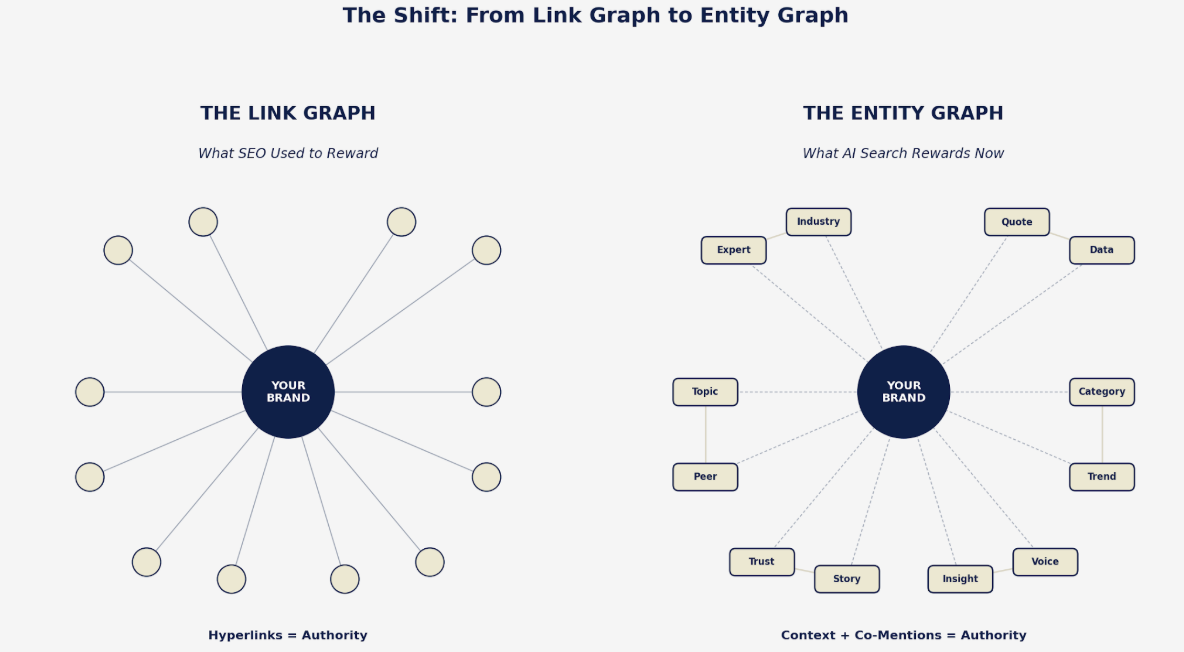
Search Engine Land describes the transition plainly: “they aren’t just counting links anymore, they’re mapping entity relationships”. The link graph is being overlaid by an entity graph, where co-citations, co-mentions, and shared context carry signal weight that was previously reserved for links.
Google confirmed this direction as far back as 2017, acknowledging that its algorithm recognises brand mentions, linked and unlinked, and uses them as ranking factors. Hike SEO notes that “unlinked brand mentions carry significant SEO and brand value”, and that Google’s increasing sophistication around entity recognition has made them a critical off-page signal.
In 2019, Google took this further by reclassifying nofollow, ugc, and sponsored attributes as “hints” rather than directives. What was once invisible to the algorithm is now part of how it calibrates trust. Canvas PR puts the implication bluntly: “A nofollow mention in The New York Times will ultimately deliver more SEO value” than a dozen followed links from obscure blogs.
Enter GEO: Generative Engine Optimisation
The entity shift is being accelerated by the rise of AI-powered search. When a user asks ChatGPT for the best mortgage broker in Melbourne, there is no SERP. There is no list of ten blue links. There is a recommendation, shaped by which brands the model has seen cited, quoted, and discussed across the open web.
This is Generative Engine Optimisation, or GEO. The Creative Collective describes the pivot simply: in GEO, “the role of unlinked brand mentions becomes more important”. Large language models use brand references as the primary signal of credibility. They cannot tell if you bought a guest post. They can tell if you are a recognised voice in your category.
Search Engine Land’s guide to GEO frames the credibility model clearly. In traditional SEO, authority is built through backlinks, author credentials, and domain authority. In GEO, authority is built through “positive mentions across trusted platforms and communities”. Different mechanism. Different currency. Different playbook.
The Data Is Unambiguous
The shift isn’t theoretical. It’s measurable.
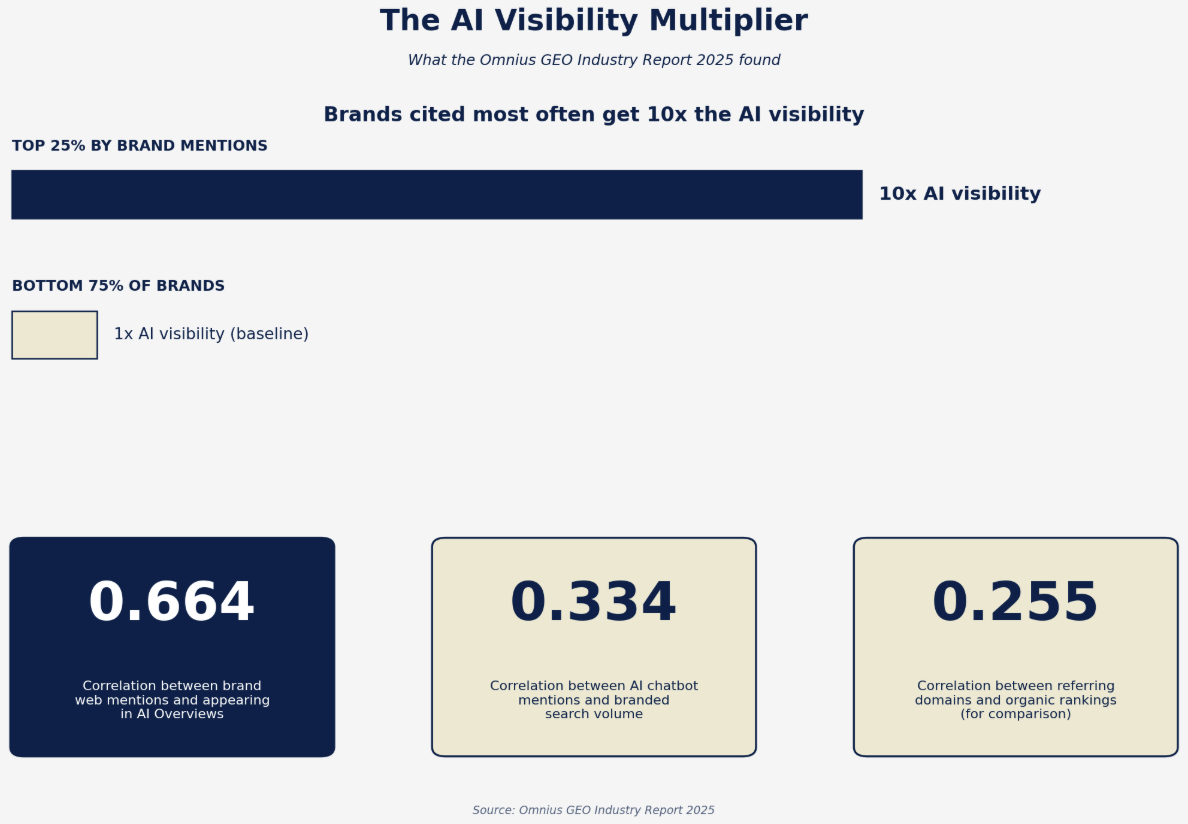
The most comprehensive study of the category to date, the Omnius GEO Industry Report 2025, puts hard numbers against it. Brand web mentions have a 0.664 correlation with appearing in AI Overviews, the strongest of any measured signal. The correlation between AI chatbot mentions and branded search volume (0.334) is higher than the correlation between referring domains and organic rankings (0.255). And most importantly: “Brands in the top 25% for web mentions get 10x more AI visibility” than the rest.
Ten times. Not a marginal uplift. An order of magnitude.
Growth Partners, in one of the clearest articulations of the new economics of search, frames it this way: “Mentions tell AI who you are, consistently, contextually and at scale”. Credible backlinks still tell Google you are trusted. Credible brand mentions now tell AI engines what you are known for, and whether you deserve to be recommended. The two work together. Neither replaces the other.
The Branded Search Loop
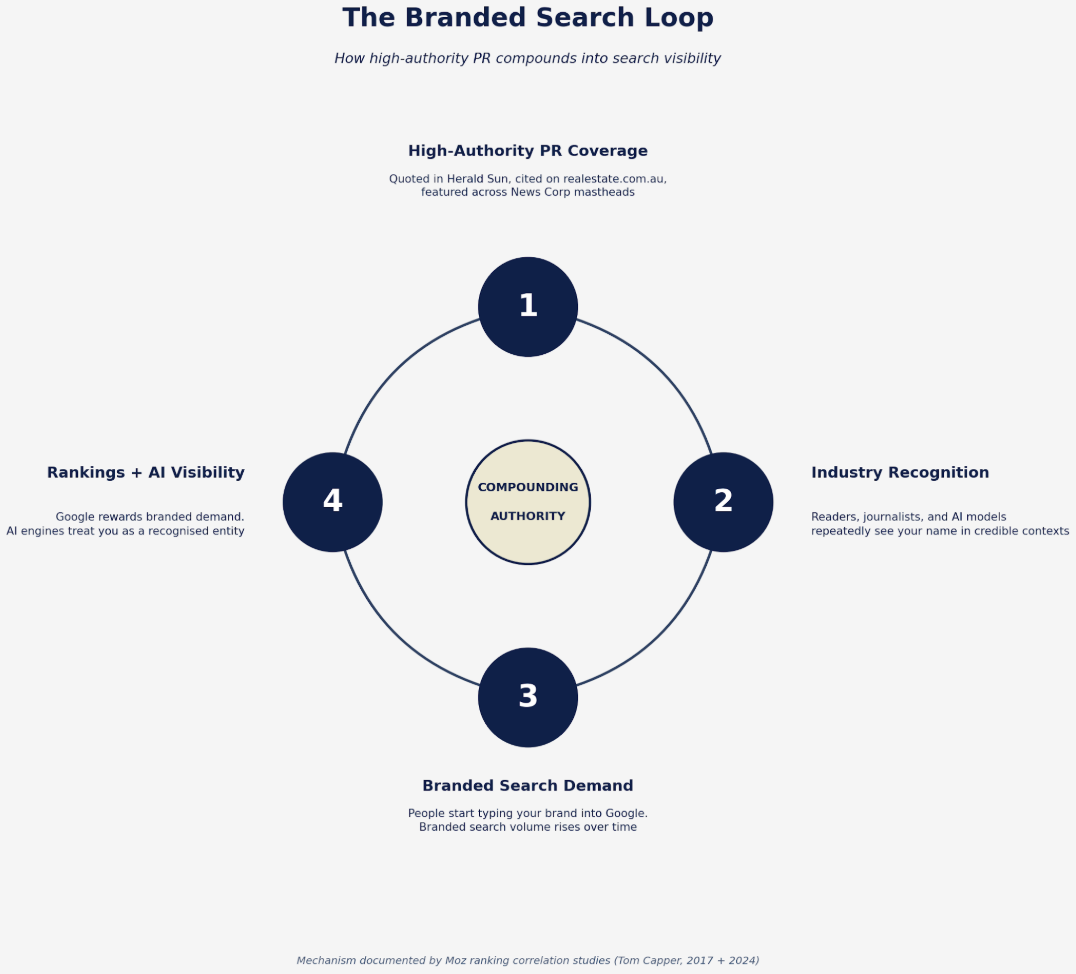
There is a second mechanism at work, one that predates AI search entirely and has been hiding in plain sight for nearly a decade. It connects traditional Google rankings, branded search volume, and the kind of earned media coverage that Published was built to deliver.
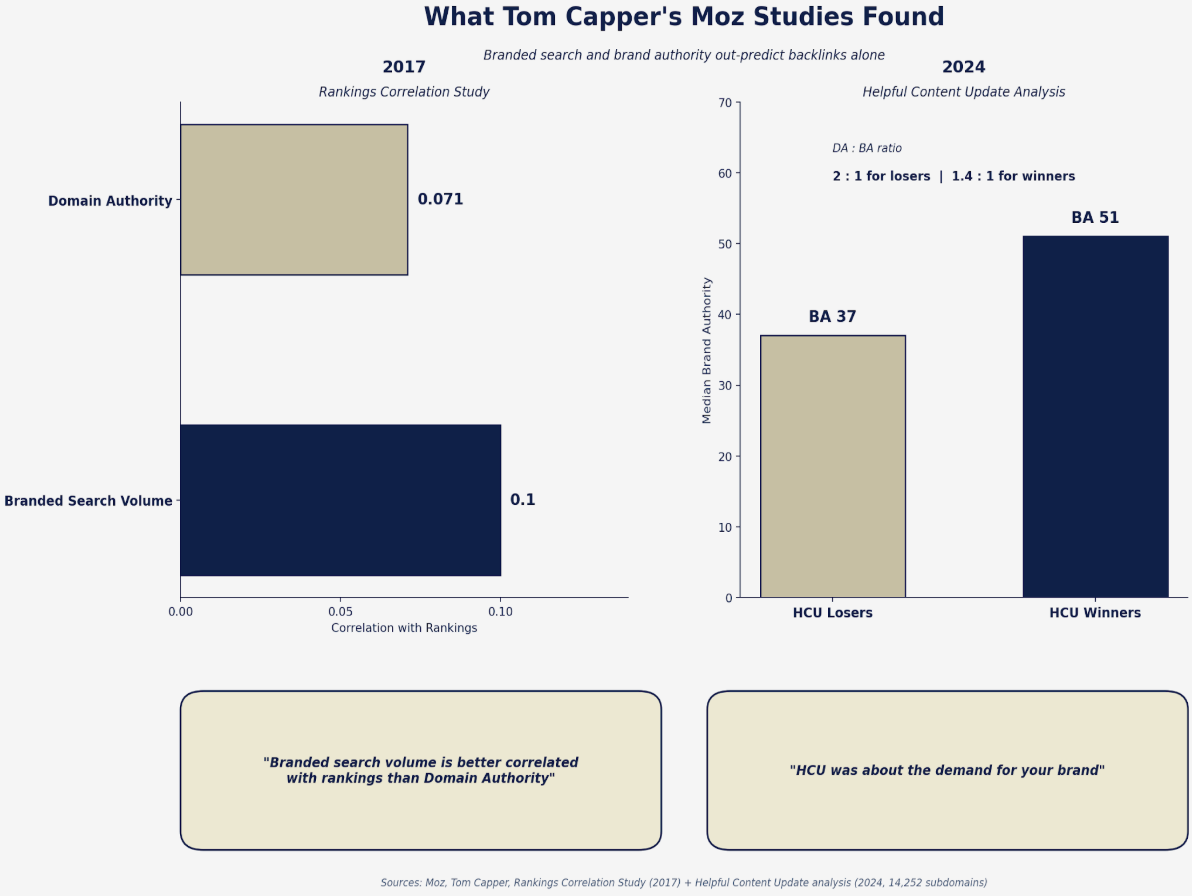
In 2017, Tom Capper at Moz ran one of the largest ranking correlation studies ever published. The finding was, at the time, heretical: “branded search volume is better correlated with rankings than Domain Authority”. Capper’s numbers put Domain Authority’s correlation with rankings at just 0.071, while branded search volume came in at 0.1. Modest in absolute terms, but a meaningful inversion of the hierarchy the industry had been operating on.
The implication was unsettling for agencies that treated link volume as the finish line. The number of people actively searching for your brand on Google was a stronger predictor of where you ranked than the authority score built on a backlink profile alone. Quality links still mattered, and still do, but they were never the whole story. Branded search was the outcome Google was quietly rewarding, and links were one of many ways to get there.
Capper revisited the thesis in 2024 after Google’s Helpful Content Updates reshuffled the SERPs. Analysing 14,252 subdomains across more than 54 million ranking positions, he found that sites hit hardest by HCU had a median Brand Authority of 37, while winners sat at 50 to 52. Losers also carried a DA to BA ratio of roughly 2 to 1, compared to 1.4 to 1 for winners. His conclusion: “HCU was about the demand for your brand”. Sites whose backlink authority outpaced their brand authority were systematically demoted. Sites where the brand matched or exceeded the links were rewarded.
This closes the loop. Being quoted in the Herald Sun, cited on realestate.com.au, or featured across News Corp mastheads does more than generate a single traffic spike. It plants a recognition seed. Readers who encounter your name repeatedly, in credible contexts, eventually search for it. Over months and years, those searches compound into branded search volume, which Google reads as demand, which in turn lifts rankings across the board.
High-authority digital PR delivers on every level that matters: a quality link when the publisher grants one, an entity-graph mention every time your brand is referenced, and over time, the branded search demand that Google has been quietly rewarding since 2017 and that AI engines are now amplifying.
Where the Old Playbooks Fall Short
None of this is an argument against links, or against PR. Both remain essential. The issue is with the way parts of the industry have historically executed them, and why those models cannot serve a brand trying to win in both traditional and AI search.
Traditional PR firms chase coverage. Their job often ends when a story lands. They rarely measure whether that placement moved an entity signal, built a co-citation with a category leader, or increased branded search volume. Their reporting stops at AVE (advertising value equivalent), a metric with no bearing on search visibility, AI citations, or commercial outcomes. A great story in a great publication is a real asset. Without measurement tied to search and brand signals, too much of its long-term value goes uncaptured.
At the other end of the spectrum sit the link volume vendors. Guest-post marketplaces and private blog networks optimise for link quantity on domains that, frankly, no one reads. This is not a critique of link building. A link from a credible, high-traffic, industry-relevant publisher is one of the most valuable assets a brand can earn, and it always has been. The critique is of the quantity-over-quality approach. A thousand followed links from low-trust sources do not build recognition with either Google or an LLM. They build noise, and they create an imbalanced brand-to-links ratio that can actively work against the very authority signals these systems are looking for.
The businesses that win over the long term have always followed the same principle: quality over quantity. What has changed is that quality now has to be measured on two axes at once. Is the publisher credible enough that a link from them meaningfully moves trust? And is the publisher visible enough that a mention, linked or not, plants your brand in the minds of readers, journalists, and language models alike?
The gap in the market is the agency that engineers authority across both. One that secures placements on publishers AI systems actually trust, treats the link and the mention as equally important outcomes, positions spokespeople as recognised industry voices, and builds co-citations that compound into durable brand equity.
Why Published Exists
Published was founded to fill that gap, exclusively for brands operating in credibility-driven industries: real estate, property, mortgage and lending, financial planning, wealth management, and insurance.
These are the sectors where authority directly drives revenue. Search engines and AI systems already hold them to a higher trust bar. Being cited across high-authority publishers is not a marketing nice-to-have. It is the mechanism by which trust gets earned and visibility turns into customers.
Our Fame Campaigns are built around proprietary data studies that national publishers want to cover. Our Authority Engine program keeps spokespeople in the media conversation on an always-on cadence. Our Link Magnet digital assets attract passive, organic co-citations that compound over time. Every product is designed around a single idea: structured, earned authority that compounds, not chased press, not bought links.
The brands that dominate the next decade of search will be the ones whose names AI engines have already learned to recognise. That recognition doesn’t happen by accident. It’s engineered.
That’s why Published exists.
Signals From the Field
The following sources informed our thinking and, collectively, document the shift we’ve built the business around. Each is worth reading in full.
- Unlinked Brand Mentions: The Hidden Gem for Off-Page SEO Success, Hike SEO. “Unlinked brand mentions carry significant SEO and brand value.”
- AI is Disrupting SEO: What Marketers Need to Know About LLMO, GEO and AEO, The Creative Collective. “The role of unlinked brand mentions becomes more important.”
- The Hidden SEO Power of Nofollow Brand Mentions in 2025, Canvas PR. “A nofollow mention in The New York Times will ultimately deliver more SEO value.”
- The Brand-to-Links Ratio Revolution, Search Engine Land. “They aren’t just counting links anymore, they’re mapping entity relationships.”
- Brand Mentions for SEO & AI Search in 2026, Growth Partners. “Mentions tell AI who you are, consistently, contextually and at scale.”
- GEO Industry Report 2025, Omnius. “Brands in the top 25% for web mentions get 10x more AI visibility.”
- Generative Engine Optimization (GEO): How to Win AI Mentions, Search Engine Land. “Positive mentions across trusted platforms and communities.”
- Rankings Correlation Study: Domain Authority vs. Branded Search Volume, Moz (Tom Capper, 2017). “Branded search volume is better correlated with rankings than Domain Authority.”
- The Helpful Content Update Was Not What You Think, Moz (Tom Capper, 2024). “HCU was about the demand for your brand.”